
The poet Publius Ovidius Naso (Ovid) was born on the 20th of March 43 BCE, the year after Julius Caesar was assassinated. By the time Ovid was entering his teens, Rome was entering a new era, with the first Emperor Augustus firmly in charge. Ovid therefore knew no time when Augustus was not leading Rome. If Augustus brought peace as he claimed, then Ovid was able to make the most of it, rejecting a life in public service for poetry. He began with love poetry like the Amores and the notorious Ars Amatoria (a handbook on picking up lovers), but he also wrote one of the greatest poems in Latin literature, the Metamorphoses, which has been influential on writing and art ever since.
In 8 CE, Ovid was 51 years old and the most famous poet alive in the Roman world – and Augustus exiled him. It was done quickly and by Augustus himself, and Ovid claimed it was because of a “carmen et error”, a poem and a mistake. We suspect the song was his early love poetry, but the mistake has never been discovered, with Ovid himself frequently claiming he does not really understand why Augustus was so angry with him. Many scholars have come up with theories: in my series of mysteries, not only does Ovid solve murders while in exile, he also gradually comes to understand what that error was.





Poetic Justice
Rome’s celebrated love poet Ovid finds himself in exile, courtesy of an irate Emperor, in the far-flung town of Tomis. Appalled at being banished to a barbarous region at the very edge of the Empire, Ovid soon discovers that he has a far more urgent – and potentially perilous – issue to address. Somebody is slaughtering animals in a parody of ritual, and the Governor’s advisor Marcus Avitius is under pressure to apprehend the perpetrator. When the killer progresses from animal to human victims, Avitius reluctantly allies himself to the mercurial, tipsy Ovid. It seems that Ovid has an inexplicable link to the murderer too, with his poetry providing the timetable by which the killer works. After a secret visit from the elite Praetorian Guard, Ovid realises he is in mortal danger. With Avitius distracted by the demands of the Governor, Ovid becomes a target for dark forces at work in Tomis – and in Rome.
“The depiction of Ovid and Avitius stands out, with both characters meticulously crafted and offering a compelling dynamic. They are supported by a cast of vividly drawn figures, each contributing to the unfolding drama and deepening our understanding of Roman society. Forsyth’s narrative prowess shines through in every element of the book, from the authentic dialogue and well-measured pacing to the underlying tension that simmers throughout, hinting at the lurking dangers in the shadows of Tomis.
Forsyth’s work is a testament to the power of historical fiction, demonstrating an ability to educate about a bygone era and entertain and engage through a story that is as thrilling as it is unlikely. Poetic Justice is a testament to the genre, proving that with enough skill and creativity, even the most obscure historical figures and moments can spring vividly to life, offering readers a window into the past that is both enlightening and profoundly entertaining.”
– Literary Titan
“Poetic Justice” is distinguished from similar books in this genre by its distinct blend of murder mystery and historical fiction, with a real-life historical person as the focal point. Forsyth does a unique and compelling job of capturing Ovid in a fictitious setting. It’s a good, old-fashioned who-done-it murder mystery, Ancient Rome edition. “Poetic Justice” has a masterfully written plot arc that builds suspense gradually and culminates in a dramatic completion. Forsyth skillfully strikes a balance between the developing mystery and the historical context, making sure that both aspects complement and strengthen one another.
Forsyth’s writing is sophisticated yet approachable. Her writing is full of punchy dialogue and haunting imagery that really bring the characters and the old world to life. The pace is well-balanced, with quieter, more reflective sections that enhance the reader’s comprehension of the people and their surroundings mixed in with tense parts.
To conclude, Fiona Forsyth’s “Poetic Justice” is a historical mystery genre masterpiece. With its fascinating plot, well-rounded characters, and rich historical context, it’s an entertaining read that teaches as much as it entertains. This book is a must-read for lovers of mystery and historical fiction alike.”
– The Historical Fiction Company

Death and the Poet
When Dokimos the vegetable seller is found bludgeoned to death in the Black Sea town of Tomis, it’s the most exciting thing to have happened in the region for years. Now reluctantly settled into life in exile, the disgraced Roman poet Ovid helps his friend Avitius to investigate the crime, with the evidence pointing straight at a cuckolded neighbour.
But Ovid is also on edge, waiting for the most momentous death of all. Augustus, the first Emperor of Rome, is nearing his end, and the future of the whole Roman world is uncertain.
Even as far away as Tomis, this political shadow creates tension as the pompous Roman legate Flaccus thinks more of his career than solving a local murder. Avitius and Ovid become convinced that an injustice has been done in the case of the murdered vegetable seller. But Flaccus continues to turn a deaf ear.
When Ovid’s wife, Fabia, arrives unexpectedly, carrying a cryptic message from the Empress Livia, the poet becomes distracted – and another crime is committed. Ovid hopes for a return to Rome – only to discover that he is under threat from an enemy much closer to home.
In this accomplished historical mystery, the author transports readers to the windswept edges of the Roman Empire with extraordinary skill and imagination. Set in the small Black Sea town of Tomis during the pivotal year of 14 AD, the novel offers a compelling portrait of exile, political tension, and hidden intrigue, centered around the poet Ovid.
The book’s greatest strength lies in its impeccable evocation of time and place. Every page breathes with the atmosphere of a remote Roman settlement, capturing the complex social dynamics of an empire on the cusp of a momentous leadership transition. The author’s research is meticulous, yet worn lightly – historical details are woven seamlessly into a narrative that feels both authentic and utterly compelling.
Ovid emerges as a particularly nuanced protagonist. No longer the celebrated poet of Rome, but a man navigating the narrow straits of political exile, he is drawn into a local murder investigation with a mix of reluctance and intellectual curiosity. His characterisation is pitch-perfect – by turns witty, melancholic, and astute. The dialogue crackles with intelligence and subtle humor, revealing complex relationships and unspoken tensions with remarkable economy.
The supporting cast is equally well-drawn. From the corrupt Roman legate Flaccus to Ovid’s practical friend and ally Avitius, each character feels fully realised. The unexpected arrival of Ovid’s no-nonsense wife Fabia adds another layer of intrigue, her cryptic message from Empress Livia promising deeper mysteries to come.
What elevates this novel beyond a mere historical whodunnit is its profound sense of political and personal uncertainty. The looming death of Augustus creates a masterful backdrop of tension, demonstrating how large-scale historical moments reverberate even in the most remote corners of an empire.
For readers who love intelligent historical fiction that combines meticulous period detail with a gripping narrative, this book is an absolute treasure. Fiona Forsyth reimagines an Ovid beyond the verses, while offering a fresh and imaginative exploration of life at the edges of the Roman world. Utterly recommended for lovers of historical mysteries, Roman history, and witty but warm stories.
BattleCat Press Reviews on Amazon
Forsyth has done it again – Death and the Poet is an extremely triumphant follow-up to Poetic Justice!
No time is wasted getting to the book’s first murder. A more settled Ovid and Avitius are plunged back into investigative work behind the death of a vegetable seller. Avitius’s growing feelings for Bella, who was introduced in the previous book, and the arrival of Ovid’s wife Fabia to Tomis stir up activity in their little community. Their intrepid uncovering of political graft was masterfully done, with some very interesting twists and turns along the way. But does it have anything to do with the crimes committed in Tomis?
I won’t reveal anything about the mysteries, as they are too well-written to spoil! Fabia’s assured handling of the situation was very fun to read. Ovid is still his humorously egotistic, self-absorbed self. Avitius putting down roots with Bella was sweet, as well. The relationships, particularly between Ovid and Fabia, are beautifully written in an understated way. I loved the small, gradual shifts in the character dynamics throughout the novel. Both the mystery and the characters are so compelling that the book ends all too quickly.
Amazon review by author A.M. Swink

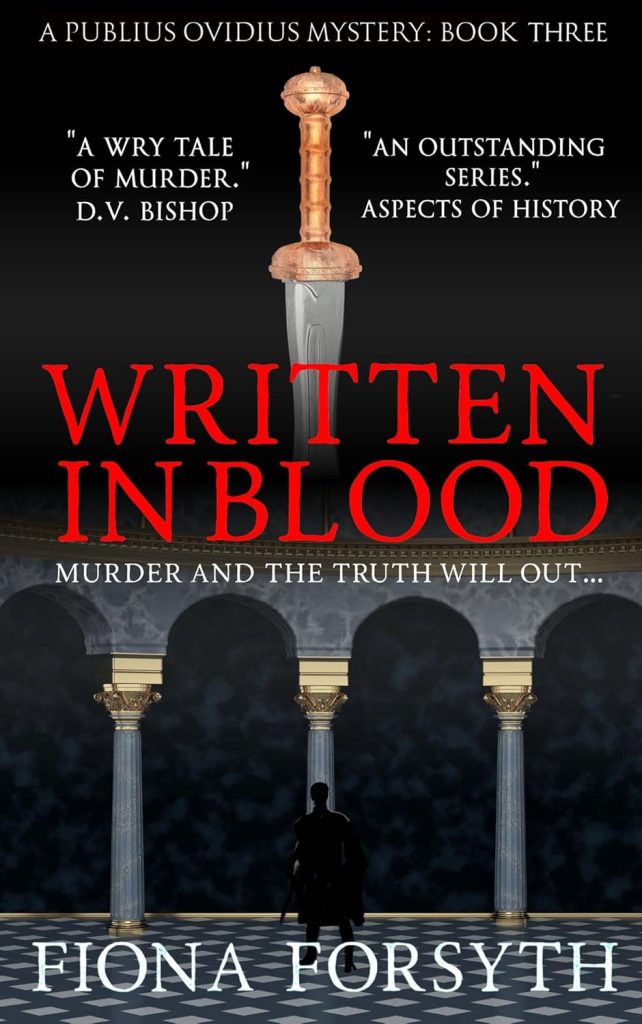
Written in Blood
14 CE.
Rome’s first emperor, Augustus, is dead.
The Empire’s new leader, Tiberius, is vulnerable. As mutinous legions rise and Tiberius struggles to control even his own formidable mother, Livia, the ripples of uncertainty reach even the shores of Tomis on the Black Sea. There, the exiled poet Ovid dares to hope that a new emperor will finally bring him home.
But Rome has a long memory and Ovid’s old enemy Sejanus is now the ruthless commander of the Praetorian Guard. His agent Philemon, once Ovid’s own servant, arrives in Tomis with orders to assess the exile’s loyalty. What Philemon finds is that Ovid has a mysterious visitor.
Ovid has received instructions from Livia herself as she entrusts him with a boy named Gaius, a child whose imperial bloodline could threaten Tiberius himself. Ovid must protect the boy and keep his presence hidden if he wants to secure Livia’s support.
When Ovid’s wife recognises Philemon, the spy vanishes, only to be found murdered on the road out of Tomis. With Rome demanding answers and the hostile legate Flaccus probing the death, suspicion turns toward Ovid. He and his steadfast friend Avitius must uncover the truth while shielding young Gaius at all costs.
Sejanus may be halfway across the Empire, but that will not stop him pursuing Ovid, his friends and Gaius. As the shadows close in, Ovid finally pieces together the dreadful truth behind his own banishment.
One of the great pleasures of the book is the development of the relationship between Ovid and his wife. When Fabia first turns up in Death and the Poet, Ovid views her arrival with some trepidation, while it’s fair to say she blames him for the inconvenience his exile has caused.
The emergence of a genuine affection between the couple is expertly handled and very moving. Far from dreading Fabia’s presence, Ovid treats her with respect and defers to her on more than one occasion. And it’s good to see Fabia, a wonderful creation, take a more central role in the story and the investigation.
But it’s not just Ovid and Fabia that Forsyth breathes life into. The whole cast of main characters are remarkably human and immediate, speaking to us across the centuries. It’s in the little observations, in the sayings (“you have enough on your wax tablet”), habits, beliefs and rituals that the past comes to life. I particularly enjoyed the lady Fabia’s fear of her slave Flora’s disapproval when she spills some ink.
Apart from the whodunnit that drives the story, there is another mystery hanging over Written in Blood. The question of why Ovid was exiled in the first place. I won’t give anything away except to say that the solution Fiona Forsyth comes up with is both convincing and shocking. It provides an ingenious ending to a deeply satisfying book. I can’t wait for my next trip to Tomis.
by Roger Morris on Aspects of Crime
https://aspectsofcrime.com/written-in-blood-by-fiona-forsyth-review/