

Ancient Rome Book News
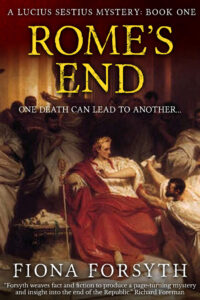
“….Rome’s End was an enjoyable read, well-researched and a different take on the period and setting, an intelligent mystery rather than action-filled story and I will definitely read the sequel to see how Lucius deals with his next challenge.”
Karen Siddall, Reedsy Discovery
“Fiona Forsyth has written an absorbing mystery using the figures of Rome’s leadership, actual historical figures, making them come to life as I’ve never experienced before”
Sherry Christie, author of “Roma Amor”
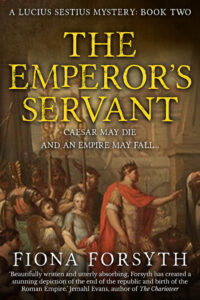
“The first two books in Fiona Forsyth’s Sestius trilogy, particularly THE EMPEROR’S SERVANT, are the most outstanding examples of grown-up historical fiction that I’ve read in a long, long time.”
Amazon review by Alex
Forsyth has a knack of bring the characters to life, so you really care about what happens. She also covers the details, from coins minted on the failed Republican side to the minutiae of religious festivals, with an easy feel for description which puts the reader inside the world. The ending, even though the build-up has been inexorable, is still shocking and gripping.

Forsyth’s prose is minimalist and unobtrusive, her characterisation sharp and multi-layered. Her plotting takes the reader towards a complex and almost intuitive dénouement.
I am off to read the first two books in this trilogy.
Amazon review
It’s probably the depiction of Rome that I find most revealing, and I loved every minute of this whole trilogy and recommend it unreservedly. It also ends beautifully and movingly. Don’t miss it.
Amazon review
Classics for All
“F. has researched her material carefully and the result is a really enthralling read, both for the student of the Late Republic or the newcomer to the period…”
Jacquie Rogers, author of “The Governor’s Man”
“Fiona Forsyth has used all her considerable powers of artistry and scholarship to bring us this fictionalised story of a remarkable Roman, giving us a woman’s perspective of the times rarely to be found.”

“The depiction of Ovid and Avitius stands out, with both characters meticulously crafted and offering a compelling dynamic. They are supported by a cast of vividly drawn figures, each contributing to the unfolding drama and deepening our understanding of Roman society. Forsyth’s narrative prowess shines through in every element of the book, from the authentic dialogue and well-measured pacing to the underlying tension that simmers throughout, hinting at the lurking dangers in the shadows of Tomis.
Forsyth’s work is a testament to the power of historical fiction, demonstrating an ability to educate about a bygone era and entertain and engage through a story that is as thrilling as it is unlikely. Poetic Justice is a testament to the genre, proving that with enough skill and creativity, even the most obscure historical figures and moments can spring vividly to life, offering readers a window into the past that is both enlightening and profoundly entertaining.”
– Literary Titan
“Poetic Justice” is distinguished from similar books in this genre by its distinct blend of murder mystery and historical fiction, with a real-life historical person as the focal point. Forsyth does a unique and compelling job of capturing Ovid in a fictitious setting. It’s a good, old-fashioned who-done-it murder mystery, Ancient Rome edition. “Poetic Justice” has a masterfully written plot arc that builds suspense gradually and culminates in a dramatic completion. Forsyth skillfully strikes a balance between the developing mystery and the historical context, making sure that both aspects complement and strengthen one another.
Forsyth’s writing is sophisticated yet approachable. Her writing is full of punchy dialogue and haunting imagery that really bring the characters and the old world to life. The pace is well-balanced, with quieter, more reflective sections that enhance the reader’s comprehension of the people and their surroundings mixed in with tense parts.
To conclude, Fiona Forsyth’s “Poetic Justice” is a historical mystery genre masterpiece. With its fascinating plot, well-rounded characters, and rich historical context, it’s an entertaining read that teaches as much as it entertains. This book is a must-read for lovers of mystery and historical fiction alike.”
– The Historical Fiction Company

In this accomplished historical mystery, the author transports readers to the windswept edges of the Roman Empire with extraordinary skill and imagination. Set in the small Black Sea town of Tomis during the pivotal year of 14 AD, the novel offers a compelling portrait of exile, political tension, and hidden intrigue, centered around the poet Ovid.
The book’s greatest strength lies in its impeccable evocation of time and place. Every page breathes with the atmosphere of a remote Roman settlement, capturing the complex social dynamics of an empire on the cusp of a momentous leadership transition. The author’s research is meticulous, yet worn lightly – historical details are woven seamlessly into a narrative that feels both authentic and utterly compelling.
Ovid emerges as a particularly nuanced protagonist. No longer the celebrated poet of Rome, but a man navigating the narrow straits of political exile, he is drawn into a local murder investigation with a mix of reluctance and intellectual curiosity. His characterisation is pitch-perfect – by turns witty, melancholic, and astute. The dialogue crackles with intelligence and subtle humor, revealing complex relationships and unspoken tensions with remarkable economy.
The supporting cast is equally well-drawn. From the corrupt Roman legate Flaccus to Ovid’s practical friend and ally Avitius, each character feels fully realised. The unexpected arrival of Ovid’s no-nonsense wife Fabia adds another layer of intrigue, her cryptic message from Empress Livia promising deeper mysteries to come.
What elevates this novel beyond a mere historical whodunnit is its profound sense of political and personal uncertainty. The looming death of Augustus creates a masterful backdrop of tension, demonstrating how large-scale historical moments reverberate even in the most remote corners of an empire.
For readers who love intelligent historical fiction that combines meticulous period detail with a gripping narrative, this book is an absolute treasure. Fiona Forsyth reimagines an Ovid beyond the verses, while offering a fresh and imaginative exploration of life at the edges of the Roman world. Utterly recommended for lovers of historical mysteries, Roman history, and witty but warm stories.
BattleCat Press Reviews on Amazon
Forsyth has done it again – Death and the Poet is an extremely triumphant follow-up to Poetic Justice!
No time is wasted getting to the book’s first murder. A more settled Ovid and Avitius are plunged back into investigative work behind the death of a vegetable seller. Avitius’s growing feelings for Bella, who was introduced in the previous book, and the arrival of Ovid’s wife Fabia to Tomis stir up activity in their little community. Their intrepid uncovering of political graft was masterfully done, with some very interesting twists and turns along the way. But does it have anything to do with the crimes committed in Tomis?
I won’t reveal anything about the mysteries, as they are too well-written to spoil! Fabia’s assured handling of the situation was very fun to read. Ovid is still his humorously egotistic, self-absorbed self. Avitius putting down roots with Bella was sweet, as well. The relationships, particularly between Ovid and Fabia, are beautifully written in an understated way. I loved the small, gradual shifts in the character dynamics throughout the novel. Both the mystery and the characters are so compelling that the book ends all too quickly.
Amazon review by author A.M. Swink